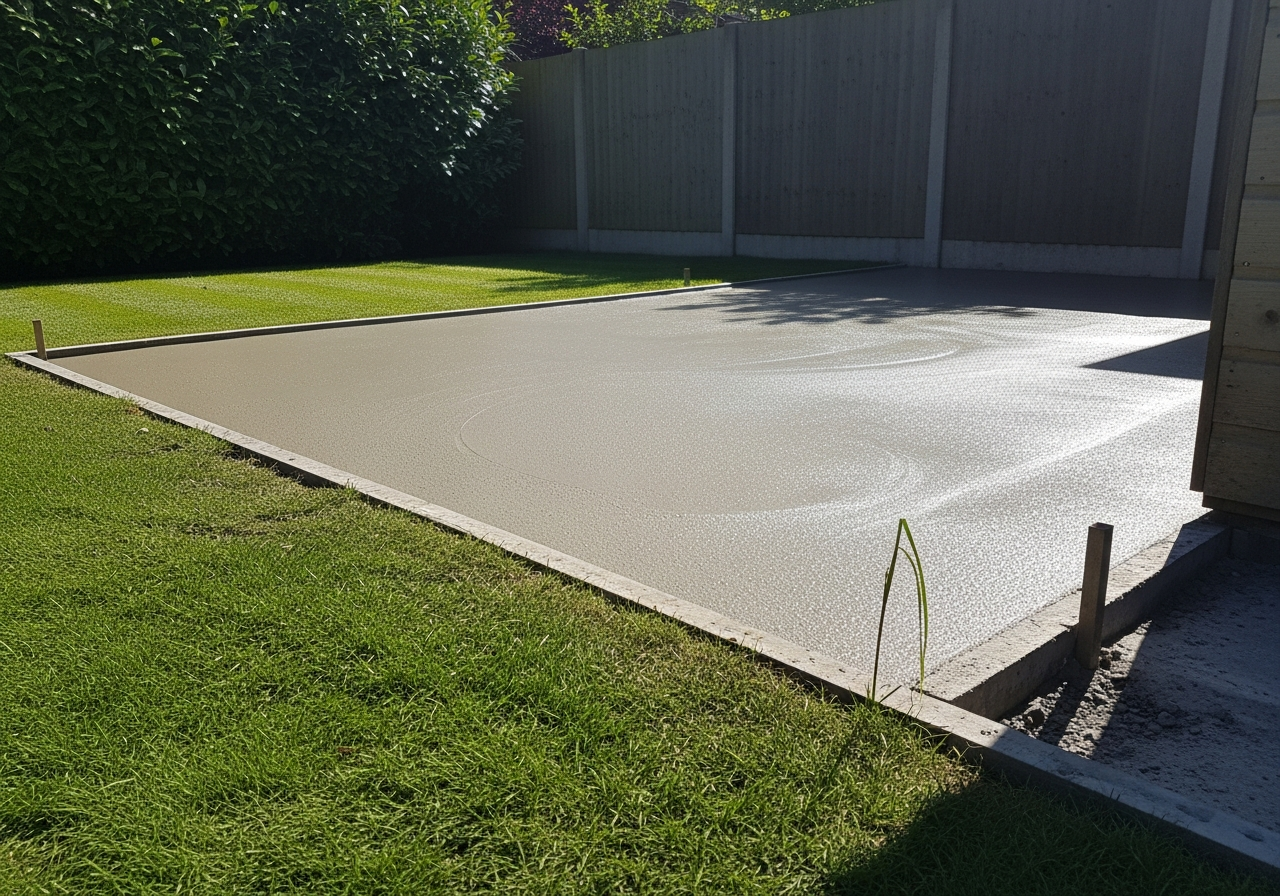
The most important bit people rush. Get this right and the rest is easy. Get it wrong and you'll be fighting it forever.
There are three main options, each with pros and cons. The right choice depends on your budget, the size of your shed, and what it's being used for.
The gold standard. Rock solid, level, permanent, and the best choice for anything bigger than 8×6 or any shed you plan to spend real time in. More work up front but lasts forever.
Best for: workshops, offices, permanent builds
The most popular option for standard garden sheds. Cheaper and easier than a full slab, removable if needed, and perfectly adequate for most sheds up to about 10×8ft.
Best for: most standard garden sheds
Treated timber bearers (or concrete blocks) raised slightly off the ground. Great for sloped gardens — easier to level. The floor needs more support but it can work very well.
Best for: sloped ground, temporary builds
The most common approach for a garden shed. Here's the step-by-step:
Hammer four stakes into the ground and run string lines between them to mark the base perimeter. Make it about 50mm larger than your shed footprint all round. Check it's square by measuring diagonally — both diagonals should be the same length. This is called the "3-4-5 method" and it really works.
Dig out about 150mm (6 inches) of soil within your marked area. Remove any roots, rocks, or general garden debris. This is the unglamorous bit. Put the kettle on, it takes a while.
Add a 100mm layer of compacted hardcore (type 1 MOT) or crushed stone. Compact it down thoroughly with a plate compactor (hire one for a day — don't try to skip this step). A solid sub-base is what stops your slabs sinking over time.
Add a 25–40mm layer of sharp sand on top of the compacted hardcore. This gives you a layer to work with when levelling the slabs. Screed it flat using a length of timber.
Use 600×600mm slabs (2ft square) for efficiency. Lay them from one corner, keeping joints tight. Use a rubber mallet to bed them in firmly and a spirit level constantly. Check level in all directions. Take your time here — a wonky base creates wonky walls.
Give it 24–48 hours before you start building on it. Fill any gaps with kiln-dried sand. Step back and admire it — that's a proper base right there.
Don't skip the sub-base. This is the most commonly skipped step and the reason most shed bases end up uneven within a year or two. Even a cheap thin layer of type 1 makes a massive difference. It's just gravel — it costs almost nothing.
More involved than slabs, but if you're building a proper workshop or home office, it's worth it.
Create a timber frame (shuttering) to contain the concrete. Use 100×25mm timber secured with stakes. Get the frame perfectly level — the top edge of the timber will be your screed guide.
100mm of compacted type 1 hardcore, then a sheet of 1000-gauge DPM (damp proof membrane). This is absolutely non-negotiable — it stops ground moisture wicking up through your slab. Overlap joints by at least 300mm and tape them.
Use a C20 concrete mix (GEN3) for a shed slab. Hire a mixer if you're doing more than about 0.3m³ — hand mixing that much concrete is horrible. Pour, screed off level with the formwork, and finish with a float.
Cover with polythene sheeting for at least 3 days to slow the drying — this is called "curing" and it makes the concrete significantly stronger. Don't let it dry out too fast, especially in hot weather.
Ready-mix concrete: For a full shed slab, ordering ready-mix concrete is often cheaper and much easier than mixing it yourself. A truck turns up, you have about 45 minutes to get it all placed and screeded, job done. Ring your local concrete supplier for a quote.
Wait time: Concrete gains most of its strength in the first 28 days. You can build on it after about 7 days but be gentle. Don't drop heavy things on fresh concrete — it's not as hard as it looks when it's young.
Thickness: 100mm (4 inches) is the minimum for a shed slab. For a workshop with heavy machinery, go 150mm and consider adding A142 mesh reinforcement in the middle.
Now for the fun bit. Let's start building the actual shed frame.